| ★ AMSTRAD CPC ★ GAMESLIST ★ DUO DRAUGHTS ★ |
Sensational Games For the Amstrad With CPC464 |
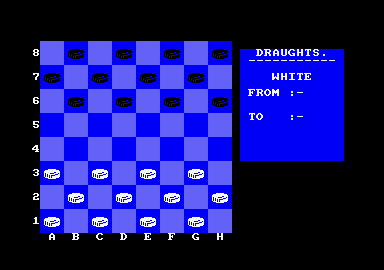
The idea is very simple you must get rid of all your opponent's pieces, by jumping over them. To jump over a piece there has to be an empty space on the other side. At the start you can only move in one direction, that is up the board if you are White or down if you are Black. To move a piece the letter for its column and the number for the row is entered. Next the destination square is given in the same way. If it is not possible to jump over a piece then any one of your own draughts is advanced by one square to another square of the same colour. If a piece reaches the other side then it becomes a ‘king' or ‘crowner'. This means that it can move up and down the board and so is more powerful. The fact that you have to take a piece when possible does not apply according to some sets of rules. Some authorities require that should an opponent's piece not be taken when possible, then the offender loses that piece. This is known as ‘huffing'. In this micro version the program will not accept an instruction which simply moves a piece when there isa jump move available. The indicator will continue to show the same colour player until thejump sequence is complete. A game can be saved to tape at any stage by pressing [shift] S. A previously saved game is loaded at any time by [shift] I.. During a game or after loading, the step mode can be selected by pressing [shift] 3. Pressing ‘Space' will then step through from the beginning. Pressing [shift] 3 will end step mode and allow the game to be played on from that position.
|
|  |
|
Page créée en 170 millisecondes et consultée 594 fois L'Amstrad CPC est une machine 8 bits à base d'un Z80 à 4MHz. Le premier de la gamme fut le CPC 464 en 1984, équipé d'un lecteur de cassettes intégré il se plaçait en concurrent du Commodore C64 beaucoup plus compliqué à utiliser et plus cher. Ce fut un réel succès et sorti cette même années le CPC 664 équipé d'un lecteur de disquettes trois pouces intégré. Sa vie fut de courte durée puisqu'en 1985 il fut remplacé par le CPC 6128 qui était plus compact, plus soigné et surtout qui avait 128Ko de RAM au lieu de 64Ko. |