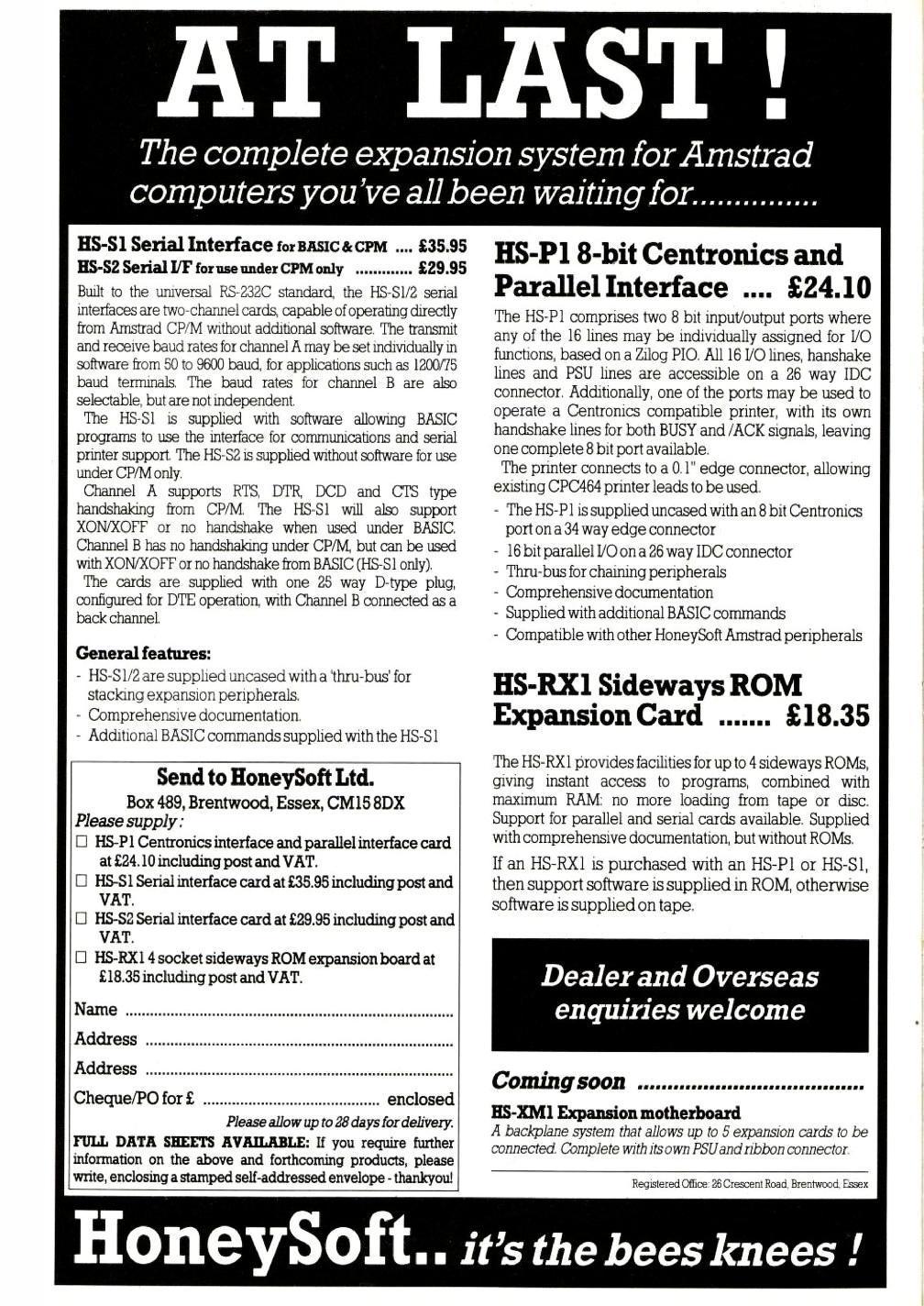
La carte HS-P1 est une carte parallèle double 8 bits dotée d'un connecteur de bord pour l'imprimante et d'un connecteur IDC à 26 broches pour diverses applications d'entrée/sortie. Les deux ports prennent en charge le contrôle de flux et chaque bit peut être configuré en entrée ou en sortie. Il est ainsi possible de contrôler jusqu'à 16 périphériques externes différents.| The HS-P1 card is designed to quickly and simply turn an Amstrad CPC computer into a powerful piece of control equipment, allowing up to 16 input or output devices to be individually controlled. TTie card provides two eight-bit parallel ports, each of which can be configured individually for input and/or output; separate handshake lines are also available. All port I/O lines, handshake lines and power connections are brought out on an industry standard 26-pin IDC connector; the I/O lines are TTL compatible, enabling easy interfacing to external equipment. The eight-bit Centronics port is an additional feature of the HS-P1; this enables an Amstrad computer to fully exploit the powerful graphics capabilities of many printers which cannot normally be accessed through the Amstrad's seven-bit-printer port. The Centronics port also supports both types of parallel printer handshaking (BUSY and ACK) and a STROBE output line (the ACK input must be greater than 10uS wide if used). Software support for the HS-P1 is in the form of a set of additional BASIC commands supplied on disc, these allow the 10 ports to be set up quickly and easily without the need to program the hardware directly. The commands include control instructions (PIO.MODE. PIO.ERROR, PIO.DEIAY): single character transfer (PIO.PUT, PIO.CET); multiple character transfer (PIO.READ, PIO.WRITE. PIO.COUNT); and a printer output command (PIO.PRINT). The HS-P1 card is built on a high quality silk screened PCB and measures 80 x 100mm (half Eurocard); it is supplied uncased with a through-bus for daisy-chaining other expansion cards, a ribbon cable connector, a 26-way IDC for the I/O ports and a 34-way edge connector (compatible with the existing Amstrad connector) for printer output The hardware is based on the versatile Z8OPIO and is compatible with the CPC464, CPC664 and CPC6128 Amstrad computers; it draws 50mA from the computer power supply. Supplied built and tested. |
|