Can no-one produce an educational game to rival the Fun School Series? DAVE COLDER puts on his thinking cap to find the answer... Have looked down at your grimey Nikes. well hard Docs or incredibly naff Jesus sandals and trought "Hey, they'd make really good cartoon characters that would be a world wide success"?' Nope? Never mind, you're too late anyway. Some bloke called James Driscoll has already done it. and made a mint out it. And he's probably made a bit more by agreeing to let his creators be turned into a computer game. Yep. The Shoe people are here and trying to achieve
that most difficult of tasks - making learning fun. And , surprisingly, they succeed. The Shoe People is aimed at four to six-year olds and comprises six activities that help introduce kids to simple spelling, addition and shape recognition. There's even a bit of drawing and painting thrown in for good measure. It's excellently presented, with some superb graphics that faithfully reproduce the characters from the TV series and books, and a healthy dose of childish humour (slapstick, in other words). Five of the activities are simple games while the final one, Margot's Magic Colouring Book, is a fairly basic art program. They're all pretty straightforward to use, but it would be still be best to have a grown-up around to encourage and advise. All the games have been designed in accordance with the National Curriculum and range in levels from easy to hard. So, for example, in The Great Alphabet Robbery, the easy levels care just concerned with letter recognition, while the later ones require knowledge of spelling. 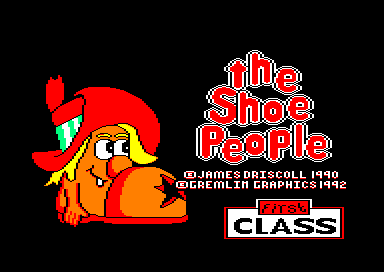 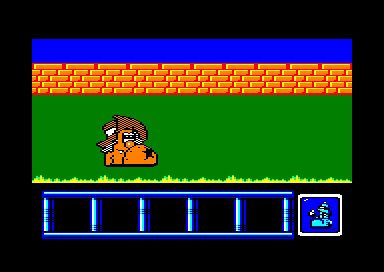
The best of the activities include Charlie's Big Day (despite the fact that they don't use the possessive 's' in the title - okay, that's a bit of advanced grammar, but in educational stuff it'd be nice to get these things correct) in which the child has to remember an ever-growing sequence of tricks. It's also the activity that makes the best use of sound - the one area in which The Shoe People falls down. The same sound effects and jingles are used throughout, to the extent that any reasonably sane parent might possibly want to strangle their child if they hear that darned fanfare again. But in Charlie's Big Day, the sonics are used well, and help with the learning process. Also good are Wellington Goes To The Park, which introduces simple Maths, and half of Margot's Magic Colouring Book, the Painting half, where the kids have to colour in pictures. Hey! it's not educational ,. but after a hard sesh at the keyboard the sprogs need to let their hair down. Its a shame that the drawing package is a bit of a let-down, though, ft is extremely limited, and the fact that nice wiggly lines are next to impossible to produce kids could soon become bored with it - I mean, how are you supposed to make smoke come out of chimneys with straight lines? There are no time limits on any of the games, which means that parents can help their kids cheat... erm, give them a bit of help and encouragement. And, for a change, the manual is very well-written with the Shoe characters themselves interjecting and giving hints and tips. Not that the kids'll be interested in the instructions - they'll be more interested in the free Shoe People book that comes with the package. It is a multi-load, but not a too painful one. For cassette users, after the initial load, the games are all arranged logically on side two of the tape, and none of them take too long to get going - a
chance to the read the book, perhaps? The Shoe People is well up there with the latest Fun Schools. I'm still not sure about the whole concept of talking shoes, though... AA88 | 













.jpg)


