| ★ AMSTRAD CPC ★ GAMESLIST ★ THE MYSTERY OF THE JAVA STAR (c) SHARDS SOFTWARE ★ |
Popular Computing Weekly | |
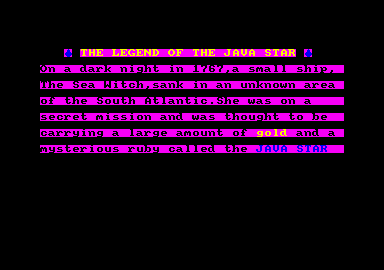
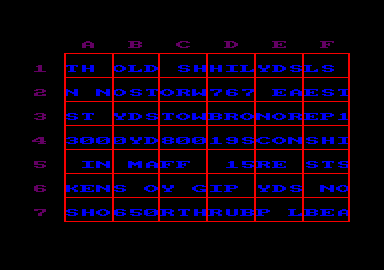
One company that usually produces interesting programs is Shards Software. Following on from its earlier epic, Pettigrew's Diary. Shards has just released two adventures that follow a similar structure. Both consist of more than one program, and in Java Star, clues discovered in early sections are needed to achieve the final goal. Mystery of the Java Star begins in Bristol, where you are shown a parchment that has been hidden in an old sea-chest for many years. Given £12,000 to begin with, you have to equip yourself for an expedition to find the fabled ruby, the Java Star of the title. Your first expense is in assembling the jumbled message from the chest. The pieces are set out like those little plastic puzzles where you rearrange the titles, and in this version you can swop pieces until the message is readable. To help you solve the problem, you are allowed to peep at the finished mission, but naturally nothing s for nothing, so each peep costs you £10. Once you have worked out the dying message from the parchment, it crumbles into dust, and you have to repeat the procedure with the treasure map. If you have seen Puzzler from Shards, then you will see that it has cleverly incorporated the graphics routines from the earlier program in Java Star.
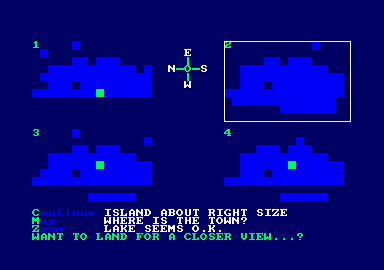
The second sub-program takes place in London, where living expenses are £30 per day. There are more than 30 different places you can visit in order to extract the vital information necessary for your trip but unsuccessful locations will cost you a days expenses. As each fresh place appears on the screen, pressing the space bar reveals details, and whether any information is forthcoming. You certainly learn about some of the more interesting places to visit in London, from Mansion House to the National Maritime Museum, and this increases the educational value of the program. Deep-Sea diving There are two more sections that allow you to explore an area of islands and to finally dive to find the true mystery behind this adventure. Although this doesn't tax the mind as much as most text adventures, it s fun to play and is the sort of software that should be used in schools, rather than the boring drills that seems to abound under the name of educational software. My one criticism is that once you reach the end, there's nothing left but to play an identical game. This, however, is a criticism of many adventure games, and it's not so easy that you'll reach the end in one evening. |
|  |
|
Page créée en 413 millisecondes et consultée 1962 fois L'Amstrad CPC est une machine 8 bits à base d'un Z80 à 4MHz. Le premier de la gamme fut le CPC 464 en 1984, équipé d'un lecteur de cassettes intégré il se plaçait en concurrent du Commodore C64 beaucoup plus compliqué à utiliser et plus cher. Ce fut un réel succès et sorti cette même années le CPC 664 équipé d'un lecteur de disquettes trois pouces intégré. Sa vie fut de courte durée puisqu'en 1985 il fut remplacé par le CPC 6128 qui était plus compact, plus soigné et surtout qui avait 128Ko de RAM au lieu de 64Ko. |