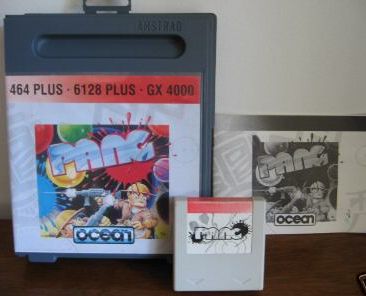
h no, it's the attack of the killer balloons! Get this. The Earth is being attacked by large, bouncy balls. The only thing standing between civilisation and domination by hordes of quivering gasbags (no, not the SDP) is... YOU.  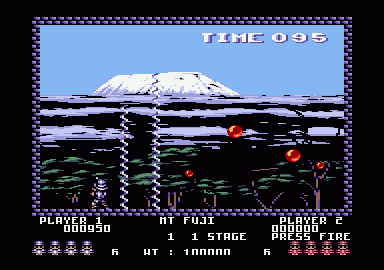
Pang is a conversion of a smash arcade game. Fans of the arcade are just going to love the Amstrad console version to death. The screen layouts, puzzles and playability are identical - this conversion is beautifully faithful to the original. There isn't really a plot to Pang, as such. All you really need to know is that at any second you're going to be attacked by one, two, three or more giant balloons. If you get hit by one you lose a life - but you do have a defence. You can fire a harpoon at these gaseous invaders, which splits them into two. OK, so you've now got twice as many balloons to dodge, but that's life. Hit these new (smaller) balloons with your harpoon, and they each break into two more... only the tiniest sub-balloons can finally be blasted into oblivion. Inside each giant balloon there can be as many as eight tiny balloons trying to get out. If you want to stay alive, you should tackle the gasbags carefully, keeping the number on the screen to a minimum. Don't take too long over it, though, because you've a time limit for each level... ...And there are plenty of levels to get through. You start off with a map of the world and the option of starting your quest at any one of several famous locations. Wherever you choose to start, there are three screens to get through before you fly (not in a balloon, though) to the next location. The screens start off easy enough, but that soon changes. Blocks start appearing on-screen, making it difficult to judge how the balloons will bounce. Some of the blocks can be shot away too (usually unintentionally!), further adding to the chaos. You soon realise that Pang isn't just a test of reflexes and strategy, but a tough li puzzle game too. For example there is one screen where as well as simply staying alive you have to stop more than a couple of the smallest balls dropping into a small enclosed section accessed by a ladder. With more than two in there, you simply can't find a gap to get in there and wipe them out... Life is certainly tough as a professional balloon-bagger, but you do have some help. If a crab appears from nowhere and goes scuttling across the screen, snapping its claws, don't worry. His claws are good at bursting balloons. If you walk into him you'll kill him, so leave him to it. You'll also encounter a large whelk now and again. He's not so good. Walk into him and you lose the ability to fire your harpoon for precious seconds. (If you walk into the crab, he turns into a whelk, by the way.) You can also collect weapons falling from punctured balloons. Your standard firearm is a harpoon (which looks like a giant corkscrew in use) but you can upgrade to a double harpoon, power-harpoon (stays on-screen for several seconds), vulcan missile (doesn't destroy blocks), dynamite (blows all the balloons into their smallest size), clock (stops the balloons for a few moments) and hourglass (slows the balloons). The thing is, these power-ups don't always give you want you want. For example, if you're right at the start of a tricky screen with loads of giant balloons, you don't really want to go blowing them all up into thousands (well, it seems like it) of little ones by picking up the dynamite. To avoid picking up weapons you don't want you have to not walk into them. 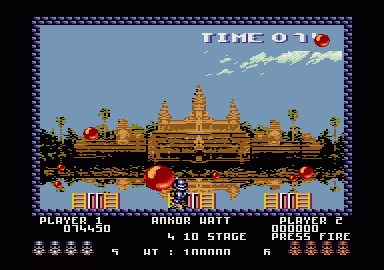 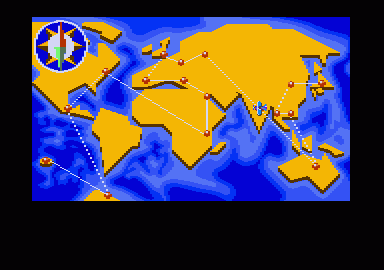 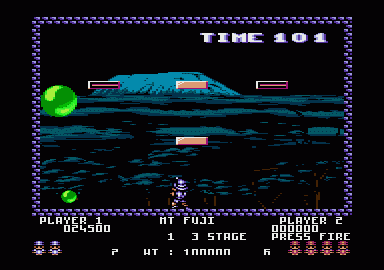 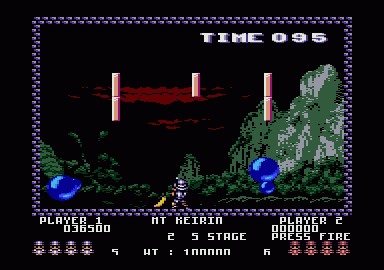
That's right, there's no jumping in this game (though there are ladders and platforms). So avoiding weapons you don't want can restrict your movements severely. Fortunately, if you don't pick them up the weapons symbols first of all flash and then disappear from the screen. Possibly the best (or worst!) thing about the whole game is the two-player mode. This is a genuine simultaneous two-player option, and you and your pal (but for how long?) play cooperatively to try to clear the screens of balloons. "...simple, addictive, maddening, and more fun than could possibly be good for you" However, although you've got twice the firepower, two brains don't always think as one. Basically, you can forget the strategy! And if just one player dies, the two of you have to start the screen all over again. Oh, frustration! Master the art of working as a team, though, and the two-player mode may help you get further through the game than ever you could on your own. With a total of 17 locations around the world, and three screens at each, there's a lot of balloon-popping to be done before your quest is over. Pang's graphics are quite superb. The intro sequence looks as if it's straight off a 16-bit machine, and although the backgrounds to each location are done in mode 0 and are a bit blocky, the balloons, screen detail and sprites have obviously been put together using the enhanced cartridge hardware. 16-bit quality? On the whole, not quite. But it is nearer 16-bit than 8-bit. The sound, too, is quite superb. The soundtrack is excellent and suits the cute nature of the graphics perfectly. Sound effects are minimal, but equally well done. Ocean has now produced some really excellent cartridge product. Pang is simple, addictive, maddening, and more fun than could possibly be good for you. It's also startlingly well done. FIRST DAY TARGET SCORE : Get to Moscow VERDICT - GRAPHICS............ 90% : The graphics are a bit blocky, but the sprites are superb.
- SONICS................95% : Excellent soundtrrack and very good in-game fx give the game an arcade feel.
- GRAB FACTOR.......92% : You'll soon grasp the gameplay, and it'll surely grasp you!
- STAYING POWER... 90% : Loads of locations, loads of puzzles and loads of difficulty.
RATING 93% : Pang is excellent! A superb conversion of a superb arcade game. Rod , AA |