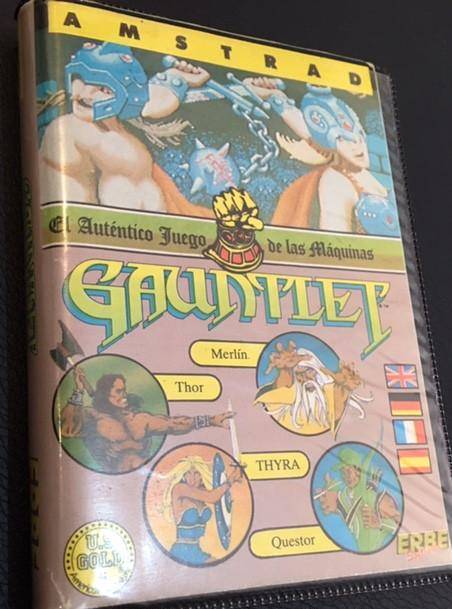
The licensing deal of the year they called it. This was it; the big one. It was odds on to be top of the charts at Christmas - almost before the programming began. You've seen the adverts, poured thousands into the arcade machine ... in fact US Gold even give you the chance to wear the T-Shirt if you enter their 'Design a Dungeon' competition. Now we have the finished (Amstrad CPC) version of Gauntlet the home computer game. In case you are not a follower of these things - perhaps recently returned from a five-year sabbatical in Nepal -Gauntlet deserves some explanation. When it hit the British arcades last year, it caused a sensation like there hasn't been for a long, long time. It had advanced graphics and some neat digitised sound. But the real thing that had the punters queueing up was the fact that it was multi-player. Up to four players could be on the machine at any one time, each taking the role of a different character; a primitive kind of arcade Dungeons & Dragons. Well over 9,000 machines later Gauntlet established itself as an arcade smash, and so became a natural target for conversion to home micros. The sceptics said it couldn't be done. The realists said it didn't matter how it was done, as long as it had the name Gauntlet on the cassette box. The first of the many rumours to surround the game and its programming team (which included the opinion that the game would never make it for Christmas!) was that the idea of more than two players on screen was a no-no. Not even the might of Gremlin Graphics (subcontracted by US Gold/ Centresoft to convert the thing) could weld four joystick ports on every target machine, so they've settled for the one/two player option, each player selecting their character from one of the original four: Thor the Warrior, Thyra the Valkyrie, Merlin the Wizard and Questor the Elf. Each has advantages and disadvantages.  
The Elf is fast and good at using magic potions, but is a bit of a wimp when it comes to hand-to-hand combat; The Warrior throws a mean battle axe and can take quite a bit of punishment from the monsters - but can it tell his runes from his pentagrams. Note that unlike Gauntlet II which has just reached the arcades, only one of each character type can take part in the game. Having made your choices, away you go and transported to Level One of the dungeon. Quite simply, each level of the dungeon is a monster-infested maze which you must hack your way through to reach an exit to a lower level. The lower the level, the harder and nastier the monsters. Death makes an appearance after a while - a black figure who can only be slain using a magic potion. The puzzle element of the game also starts to come into play after a while — when the mazes get complicated and you have to start knocking down walls to get anywhere. Time is important. You start off with 2000 strength points but the stress of being surrounded by all these perils mean it's counting down all the time (just like real life, mortals) and when you get hit by the opposition it goes down even faster.
Strength can be regained by collecting food found lying around the place, so playing the two player game you get to know who your friends are pretty quickly as you both make a grab for the goodies. And no fantasy trip would be complete without treasure, would it? Gauntlet is no exception, and collecting it will increase your score - as does laying into the natives. Gauntlet the computer game passes the conversion test easily. At least as good as it could be on a home micro. Best played with two of you, shouts of 'Cover me, Bodie!', fill the room and it's not a bad romp as you give thousands of Evil Things exactly what's coming to them. Gauntlet was never about intellect - just hit that fire button and take them apart. And there is the possibility that without the puzzle elements of some games of a similar genre (say, Druid) or the flashy effects of the stand-alone, there won't be much to hold you for a long period of time.
But make no mistake, if you want to play Gauntlet no frills, on your home computer this Christmas (and although we've only seen the CPC version, there's no reason why the others shouldn't be of a similar standard) - US Gold has delivered the goods. John Cook, PCW |