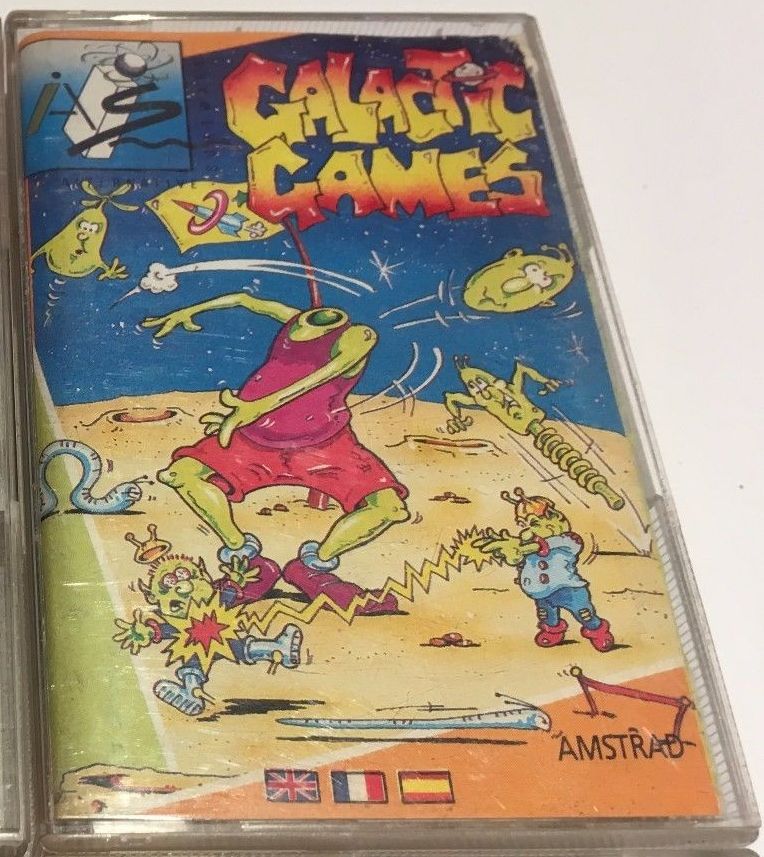
THIS unlikely collection of warped wonders masquerades under the concept of an interplanetary Olympics, and must be among the motliest medley ever seen on the Amstrad. Let's get one thing clear - these games are weird. The collection has much the same feel as the track and field programs of a couple of years ago, only I can't see the 100m slither, space hockey, psychic judo, head tossing, or the metamorph marathon being eligible for Seoul this year. The 100m slither puts you into good old worm mode, attempting to burn up a 100m track in under 70 seconds. Any longer and you will be disqualified. I really need not tell you of this contingency because if you play the game, you will no doubt experience such an occurrence. The blasted Wormoid is hellishly difficult to get moving at a reasonable pace without raising its temperature so much that it burns out. This 100m is not the joystick-breaking dash of a typical race amongst humans, more a skilful manipulation to get a reasonable rhythm going.  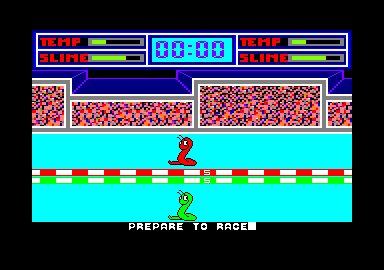  
Space Hockey is an excellent advanced variation of the old TV football games. You knock a puck around the screen attempting to force it into your opponent's goal. Sounds simple doesn't it? The puck is a living creature which visibly grimaces as you hit it. Thus to the limited extent of its mobility, the puck tries to avoid being hit. The goals are not standard, they're black holes which will also suck in players if they get too near. A final consideration is that the whole game is played in deep space. Hitting the ball or colliding with the opposing player will result in you bouncing back from the point of impact. The consequence of all this is a game bordering on mayhem until you get used to the style of play needed to score points over the four 60-second quarters that constitute one match. Head throwing bears a fair resemblance to the computerised javelin game. You get your character to the starting line with as much momentum as possible, press the Fire button, and off flies his head. Further control of initial trajectory and angle of landing are available to ensure you get a long even flight with the head's nose landing firmly in the astroturf. A nice resounding scrunch is heard when this occurs. You also have the option of waggling the head's ears in mid-flight to gain a little extra distance. Psychic judo and the metamorph marathon bear no obvious comparison. The former is a combat game involving you attacking various sectors of your opponent's body, whereas the latter pits you as a many-shaped being travelling a large circuit, slipping into your various guises to complete different parts of the course. Although the two player option for all these games utilises both keys and joystick, the one player against the computer mode appears to insist on the joystick being used. Though the controls are extremely good, the keyboard player looks to be at a bit of a disadvantage. What these games all have in common is a great sense of fun. There is considerable humour, not the unfunny schoolboy antics and innuendo of unfunny schoolboy programmers, but a few quips and jokes included in the game design that do not cease to be amusing after one or two plays. With the exception of the metamorph marathon, and to some extent the 100m slither, all the games were straightforward after a bit of practice. I particularly enjoyed space hockey when played against the
computer. The computer's skill level - which was not selectable - seemed ideal in that it was a notch higher than mine, enabling me to win the odd victory but to improve against it as well. All five programs are selected from disc via a menu which outputs a brief scene-setting page. This is printed on-screen using a slow but novel method, which can be avoided, and the next event loaded in. You can save your results and complete a full five-game championship. To make the best use of this option, as well as not to die of boredom while waiting for a new event to be loaded in, you really need the disc version. It is such simple but useful considerations as the above, plus the ability to choose to play the games in whichever order you like, that marks this collection as a grade higher than many others. The events are not only whacky but they are quite wonderful. well designed, full of detail, and eminently playable. I'm hooked and I'll wager that many others will be too. Clive Gifford, CWTA
|