Flare One pokes its head out- body due later
A revolutionary new games machine is slowly being dragged through birth by three former Sinclair Research men, promising a speed closely rivalling the Amiga and even the Archimedes - despite its old-fashioned 8-bit Z80 processor. It's been unveiled. But contrary to reports in some computer magazines the Flare One won't be on the shelves this Christmas for £200, or even £20,000. According to Cambridge-based inventors Flare Technology the earliest possible launch dale is some six to 12 months away, at about £200 with a software bundle. And as yet no-one has agreed to actually produce the supermachine, which would require an investment of five to ten million pounds. TGM has learned that Flare approached Amstrad and were turned away. Apparently another firm is now interested. Sinclair origin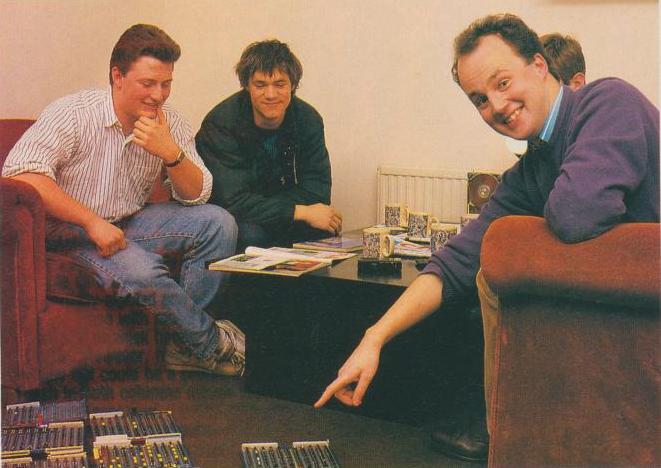 The genesis of this console-style computer lies in Sinclair Research, home of the original Spectrum, where the Flare One's three designers began work on the famous 'super Spectrum ' - Loki. But when Amstrad look over Sinclair in 1986 many technical people had to leave. John Mathieson, of Flare Technology, with the TMB Development Team. On the floor, the original prototype Flare PCB. >> Determined not to let their hard work go to waste, John Mathieson, Ben Cheese and Martin Brennan established Flare Technology. High performance The Flare One's designers hope for top performance by combining two custom chips with the main Z80 processor, controlling 768K of RAM. There'll be a video/blitter chip enabling up to three million pixels to be plotted in one second, and a Digital Signal Processor for audio - a RISC (Reduced Instruction Set Computing) chip, as in the Acorn Archimedes. About the size of two TGM pages, it will have no keyboard, and will load software from cassette at about 2K per second - so it will take some six minutes to fill its RAM. The operating system, held permanently in the machine's 128K ROM, will be based on CP/M. Sight and sound On the visual front, the Flare One will have 128K of video RAM, onboard Genlock-style computer/video image overlays and a high-resolution definition of 512 x 256 pixels, though only 256 colours. Sound output will be in stereo. A full complement of MIDI ports and a built-in analogue-to-digital converter, enabling samples to be taken, will be included. Software bundle Three software packages are likely to be included in the price: one graphics and two sound utilities, controlled by icons and windows. FlarePaint will be a straightforward art program, although a frame-grab-bing facility (a video digitiser) may be included. FlareSynth will be a voice editor, controlled by altering graph shapes and with user-friendly commands. And FlareCompose, for writing music, will be fully MIDI-compatible and able to incorporate samples. Analysis: good luck! After the recent arrival of the PC Engine, the games console world has reached its second stage. There's a strong possibility that the Sega and Nintendo will take the budget seat -they're now at £79.95 to £129.95 and £129.95 to £189.95 respectively -while the Flare One and PC Engine become state-of-the-art games machines. And Flare Technology are in a position to rival even the Commodore Amiga and Atari ST if a Flare with 3.5 " disk drive is produced-as is planned for later models. An IBM-stan-dard port will allow users to attach a keyboard easily. The Flare One clearly could beat the ST hands down on the music front, too. But first Flare Technology need a manufacturer. With most of the established home computer firms - Acorn, Amstrad, Atari and Commodore -committed to their own 16-bit machines, support from them seems unlikely. Perhaps a company from outside the micro area could step in, as happened when NEC took the PC Engine under their wing. Let's hope the Flare three succeed. At £200, with a stunning software bundle, their machine could make the 16-bit revolution a dud. TGM |