| ★ HARDWARE ★ AMSTRAD LQ 3500 ★ |
| IMPRIMANTE LQ 3500 (AM-Mag) | AMSTRAD LQ 3500 (A&B Computing) | AMSTRAD LQ3500, MATRICIAL DE 24 AGUJAS (Amstrad User) |
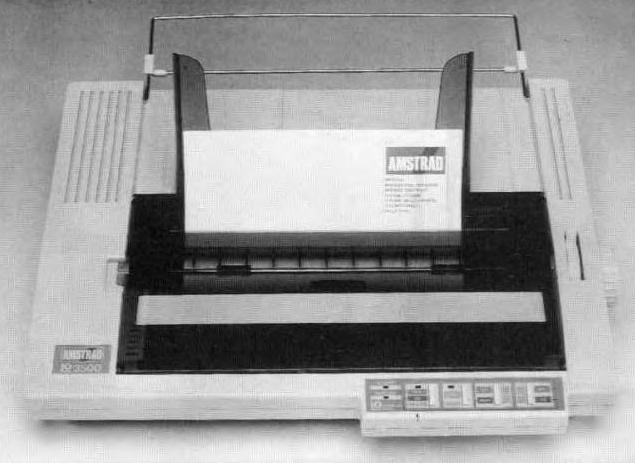
The Amstrad LQ3500 24-pin letter quality printer will work with IBM PC compatibles and any other computer that has a standard (Centronics) parallel interface, ie all BBC machines. It measures 436mm wide x 335mm deep x 85mm high overall, excluding connectors, detachable tractor and paper guides, and weighs approximately 6 kg. The tractor unit was not supplied for review. When it is not fitted, the open top of the printer can be covered by two plastic flaps, one of which has a slot through which the paper feeds, and is equipped with two adjustable paper guides which fold down when not in use. These are rather tatty, and inspire little confidence in their longevity. The other flap is lifted to obtain access to the ribbon cartridge, and appears to be usable with the tractor fitted. There is a protruding ledge on the right front, which carries four switches - these include the normal on-line, line feed and form feed functions. The fourth switch, labelled MODE, modifies the operation of the line and form switches, reducing the line feed to 1/80 inch, and changing the form feed to reverse line feed. These switches can also be used to select draft or letter quality. The usual DIP switches are fitted, and a good feature of the design is that these are immediately accessible through a cut-out in the rear of the case. A convenient automatic feed can be obtained when the printer is switched on. by offering the paper into the rear of the roller, and pulling back the bail-bar lever on the right of the printer. The print head then moves to the middle and the paper is automatical!/ fed forward, finishing with the print head about 30mm below the top of the paper. Once loaded, the paper was not very well held by the rollers, and it was all too easy to knock it out of square during printing. The claimed printing speeds for standard type (80 characters per line) are 135 CPS (draft) and 45 CPS (LQ). The measured speeds, including line feeding and all other overheads, were 80 and 36 CPS respectively. The LQ3500 can produce Epson, or either of two IBM fonts. All character sets can be in standard or italic styles, and can be selected either by DIP switch or by software control codes. The typefaces available are pica, elite, condensed, proportional and LQ. ary of which can be in subscript, superscript, double-strike, italics or bold. Any of these combinations can be underlined or printed in double width. Downloaded character sets can be used, and codes from 0 to 127 are accepted, but those which duplicate control codes will not be printed - for obvious reasons. The printer has an 8K memory, in 2x4K of RAM of which 1K is reserved for downloaded characters, and the remaining 7K is the printer buffer. This is a useful buffer size, which would mop up roughly a full page of A&B text. It is possible to get a printout of the ASCII code (in hex) for each character sent to the printer, for example, when listing a BASIC program. The ASCII codes are followed. on the right of the paper, by the characters themselves. This facility is only available at switch-on. and is dancelled by turning the printer off again. Hot Head Single, double and quad density graphics are available, giving 480, 960 and 1920 printing positions per line, respectively. However, the use of graphics did pose some problems on the review sample. The print head has 24 pins in two vertical lines of 12 each, and the firing pattern depends on the printing mode in use, all 24 being used for 24-bit graphics. The problem is that the head is inadequately cooled, having little in the way of a heat-sink and no cooling fins Although there is a brief pause at the end of each line to reduce the duty cycle slightly in this mode, the head still gets extremely hot after a few passes of black background. If printing is allowed to continue, a thermal cutout stops it for a cooling-off period at about 130 degrees Celsius. On the other hand, restricting oneself to 8-pin mode gives thin results. This seems to sacrifice much of the potential benefit from the use of 24 pins in graphics modes. It is also worth noting that although standard printer dumps, designed for ordinary 8-pin printers, do work after a fashion in 24-pin mode, they give thin and dimensionally distorted results, due to the different printing modes involved. Some dumps specifically for 24-pin pnnters have been published, one of which was used for test purposes (briefly!). Doubtless 24-pin dumps will soon be widely available. Thanks Amstrad! Normally a printer review should be illustrated with some print and graphics examples. Unfortunately, the review sample arrived in distinctly second-hand condition, with no tractor or paper separator, a loose connector and a well thrashed ribbon. A replacement ribbon was sent, which proved to be a carbon type instead of the proper inked one. and consequently useless for practical purposes. By this time it had also been discovered that one or two of the lowest pins appeared not to be printing reliably. On inspecting the circuit board a modification confirmed my suspicion that the printer supplied was an early sample. It is unfortunate that a looming copy date left insufficient time to obtain a full production sample of this printer in ex-factory condition, but the bottom line is that one can only review what is received. On paper the LQ3500 looks good, has some good features, and should be a serious competitor for the Epson. Citizen or the NEC but clearly I cannot recommend it on the basis of my experience. However. Amstrad have told me that the head performance has been much improved, to the extent that the printer has been shown continuously dumping graphics at exhibitions. A new 15" model (LQ5000) is about to appear, with dual inputs (serial/ parallel) and a speed of 298 CPS in draft mode, or 100 CPS in LQ. The price will be about £460 including VAT. and we hope to review this in due course Factfile
|
|  |
|