| ★ GAMES ★ SOURCE OF SORCERY (AMSTRAD COMPUTER USER) ★ |
Electronic Dreams (Amstrad Computer User) | Escritores eléctricos (Amstrad User) |
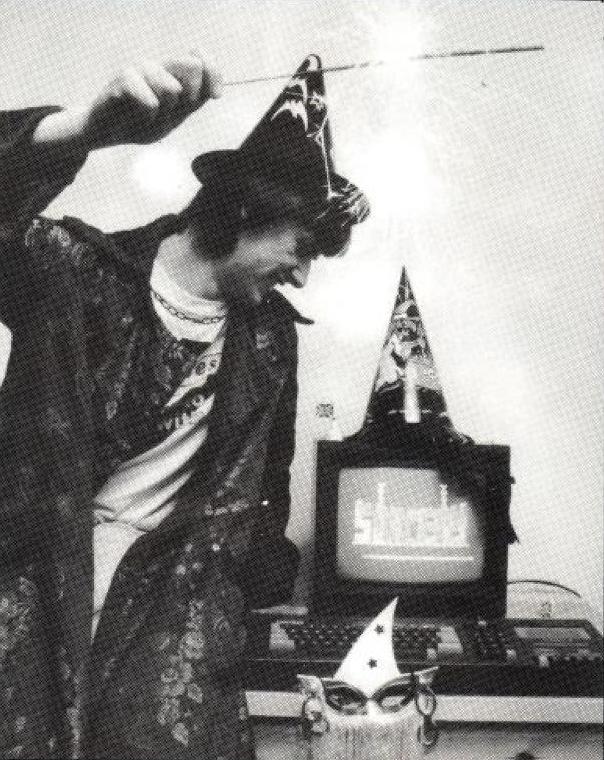
Virgin Games have an image of being so laid back that they often fall over! Simon Rockman went to investigate the source of Sorcery. Many companies with a lot of money think that they can succeed in the home software market; after all, surely all it needs is a reasonable product and a lot of hype. Initially Virgin fell into this trap and published the best of the poor software sent to them in response to the 'Be a star!' advertisements they put out. Despite the popularity of The Laughing Shark character portrayed in their advertising, the actual software acquired a poor reputation. Virgin had learnt the hard way that word-of-mouth is the best way to advertise software, and re-trenched for a second attack on the home software market. It is lucky for the CPC464 that it arrived whilst Virgin were climbing back in the software stakes. The result is Sorcery - the best game for the Amstrad computer yet. Rapid expansion Virgin are based just off the trendy Portobello Road, filled with quaint shops and a street market. The road in which the main offices are situated, is a cobbled street. Behind builders' skips and scaffolding, a handwritten sign proclaims ‘Virgin this way....'. Inside, the builders are at work. The place smells of plaster and fresh paint - pillar box red. Since Virgin started as a record company they have grown. The records, films, video, and airline departments are in an adjacent road, and the games division has not yet moved in (preparations are being made). The receptionist handles the switchboard like a typewriter, dealing with the large number of calls. Somewhere in the background, above the noise of the builders someone is discussing ‘products' and ‘units'. Virgin is a very busy place. Dave proves he's an AMSTRAD wizard >> The actual programming is done down the road. Behind an elegant Edwardian door there is a swish reception, a telex, and yet more building work. One room looks lived in - the programming room. The place is the nicest possible kind of tip, a sort of computer scrapyard. Having just returned from a computer show, much of the stuff is piled up on the floor. Apparently it all used to fit on the shelves, but having been removed, mess has accumulated in its place and there is no room for the equipment. A QL sits on a shelf, covered in dust. This is where Sorcery was written. Quick as a flash A lot of work went into the game and this shows t right from the moment that you start to load it. The program uses a system called 'Flashload' - a high speed loader. All recent Virgin games use some kind of high speed loader. This was essential with the Commodore 64 which loads at about a third of the speed of an Amstrad speedwrite 0 program. So although the need was not so great on the Amstrad, it was decided that the 2K of memory used by the tape buffer was too valuable to waste and so some kind of custom loader was required. This caused a lot of problems and only came right in the end. The original idea was to load at 4K baud (four times speedwrite 0) but whilst this was okay most of the time, it proved too unreliable to be used in the manufacture of a large quantity of tapes. The speed was cut down “bit by bit'until a reliable enough result was obtained. The production tapes load at 2.5K baud but without the usual gaps between blocks. Even so it is a large game and takes a while to load. The possibility of a disc version is a sore point, since their disc drives were still on order. The whole game was developed using a tape based system and Devpac. All done on an Amstrad Development systems are a matter of taste. Some companies like Abersoft (who wrote Forth) share mainframe computers, some use mini computers and some use different micros, the Apricot being a favourite. Programmers tend to stick with the systems they like or have good utilities for and write their programs on that. They use a link to transfer the software to the machine it is intended to run on at the last minute. Virgin are one of the few major software houses to do all the work on the machine that the program has to run on. Dave, who wrote most of the program for Sorcery is quite happy working like this, however Andy dislikes the Commodore 64 he is working on and would much rather use something with fast discs. Utility software is important and in addition to Devpac 2, the Virgin team use a multi colour character definer they have written. All the graphics are produced by Ian who created the forty breathtaking rooms with only 256 characters. The definer itself is complicated to use, and there is no intention to release it as a separate program. Magical tricks If you have seen the game you will know that the top of the screen is in mode 0 whilst the bottom is in mode 1. This is done by waiting for the electron gun in the monitor to get half way down the screen and then swapping the mode. This gives plenty of scope for the graphics, with 16 colours at the top, and nice text at the bottom. The book which forms a timer disappears four pixels (dots) at a time since this was the easiest way to write the program since four pixels correspond to a whole byte. A bug! There is one, minor, bug in the program. When your sorcerer flies behind a waterfall he sometimes leaves a copy of himself behind the water. Initially Dave attributed this to ‘refraction' but then admitted that this was the way his sprite routine worked by using XOR. He pointed out that there were no rooms where two monsters of the same type could cross since this would cause them to disappear. Being a Spectrum programmer this was the first time he had been given so many colours to play with. Ian really went to town with the graphics. There are a lot of little things to notice in the game, and things like which cauldron is friendly and which is evil, depend upon your starting position in the game. There is an odd message if your name is Hugh and you manage a high score. All these little things improve the game. The future There are two projects being considered for the future. The first is Strangeloop, a conversion of the Spectrum hit, and the second is as yet without a name or storyboard. All in all, there should be four more programs from Virgin this year with a particularly good one saved until Christmas - yes it does seem a long way away. Having established such a good reputation on the Amstrad machine it is important that all the follow up software is as good. Overseas readers will be pleased to hear that Virgin will export its software, notably through Virgin France. Dave refused to be drawn on the unnamed game, saying that it could be anything, although it was unlikely to employ wire frame graphics - they lack colour, and his expertise is in moving large, pretty shapes smoothly across the screen. Any future programs will have more exciting sound, in stereo. Whatever happens, Virgin are a name to watch. Now I must grab my joystick and find out what the crown does... ACU (Amstrad User May 85) |
|