Scene: the back streets of a decaying urban jungle, where vicious street gangs face each other in Britain's traditional combat sport, soccer This could end in glory, disgrace or serious physical injury. These boys stop at nothing to win, and scoring a goal is no guarantee that it will count. Footballing ability must be backed up with aggro. Here nice guys don't finish first - in fact, they're lucky to finish at all. This is the continuing scenario of Street Gang Football, an adaptation from the childhood memories of millions of would-be Maradonas, Vinilie Jones and Tommy Smiths (the Liverpool hatchet mail, not the Glaswegaln saxophonist). Most of us have played footie in between parked cars, breaking windows and doing a runner. This blast from the past also has the advantage of exploring an established concept (i.e. Street Soccer, on Four Soccer Sims), as well as a fertile ground for humour. Is that what we get? No chance. Streetgang Soccer features graphics borrowed very nearly straight from the original. They are a little smoother, admitted, and the colours are a little better, but not enough to justify nearly four months' work. Everything is too small and too indistinct to be any fun to play. When your players run up screen to score, for example, they obscure the ball - an unwelcome bit of realism that helps to ruin gameplay. The whole premise of 'Off-Pitch football is that the surrounding area makes ball-control difficult. Difficulties can be coped with, impossibilities cannot. The ball behaves completely randomly, supposedly in line with real street football. But a game should feature as much skill as luck, or how can you influence what happens?] 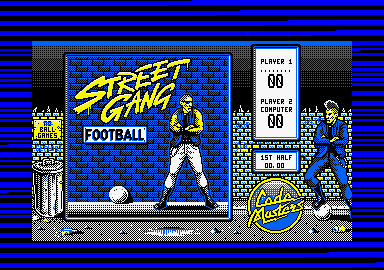 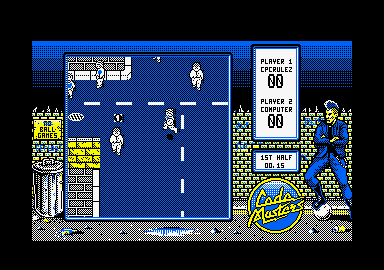
The object, of course, is to pass, dribble and pray to gel the ball to the other gang's goal area more often than your opponent. Once there you have the tedious task of avoiding the 'dead ball' zone to score. It is here that the major new side of the game becomes apparent. Just like real soccer, everybody argues and unlike real soccer arguments turn into full-scale brawls. The arguments appear as speech bubbles from mugshots of some pretty unsavoury characters (nothing like the players, by the way). The row escalates until :hey come to blows, and again the scene shifts, this time to a brawl scene. This element could have been exploited to the full, Renegade meets Match-day style. Once again, however, the full potential of the game is missed and all the fight consists of is a high speed waggling contest. Is this how disputes are settled in the roughest gangs this side of the Bronx? Call me a vulture (you're a vulture - ed) but you don't even get a chance to see the blows getting landed - just a comic book cloud of dust. Even more irritating is the waste of another good concept: when the ball bursts, you get to play with a tin can. Now here was an ideal comic opportunity to introduce a whole host of unsuitable ball substitues, but no, it's always a tin can, and the joke very soon falls as flat as the ball. The final nail in the coffin comes when the opposition get fed up and storm off in a shower of expletives. What can one say about a game so dull even the sprites want to go home? The violence promised on the cover is never delivered, and the tongue in cheek tone of the concept is never around for long. Street Gang Soccer takes you straight back to the bad old days of football sims, where the appearance of man-shaped spites and an interesting backdrop were more important than gameplay. To be perfectly frank, now the genre has matured with Gary, Emlyn and MicroProse this all looks rather amateurish. A good idea and hard work have been squandered, and the disappointing result is a monstrously boring and needlessly fiddly game. FIRST DAY TARGET SCORE : stay interested TW,AA | 












 +
+


