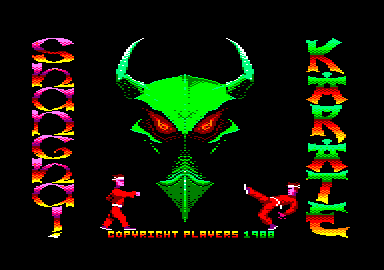 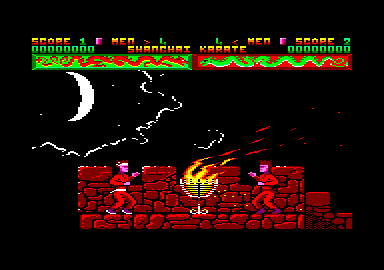
TELL us a story, honourable grandfather, the children ask. And so begins the old Japanese sailor's tale of how the evil Wang Chen, a disgraced former pupil of the Changchun Karate Academy, broke in with his warriors and killed all the masters and pupils - except Lo Yin who escaped with the sacred karate scrolls which he was studying at the time. If the members of the academy were so good, how come they let a disgraced pupil kill them all, that's what I want to know, and what's a Japanese sailor doing telling a Chinese story? The game follows Lo Yin on his journey to Shanghai, where he eventually gives the scrolls to his friend Derek who takes them to Slough. How's that for an atmosphere killer? The action takes place in four locations on Lo Yin's journey. The first is by the Great Wall, the second is in the forest by the banks of the Yangtze, the third is in the Loyang caves -complete with giant spider -and the fourth is in the Dragon temple. You can kill your opponents by karateing them to death or, in the Great Wall scenario for example, by pushing them off the wall. Two dragon scrolls at the top of the screen record the energy level of the two fighters and when you die you sort of teleport up into space. The eight joystick directions correspond to six movements, and with the fire button pressed produce seven kicks and punches. It's easy enough to move and punch in the desired direction but a little thought is needed in order to perform a specific block or kick. If you want to duff over a friend, there's two-player mode - the second player uses the keyboard - which in many ways offers a fairer challenge although you can't progress through the game. Shanghai Karate is an accomplished effort, but it does smack slightly of a budget production - which of course it is. Still it's definitely worth a look whether or not you're a karate fan. Ian Waugh, CWTA
| 













 +
+


