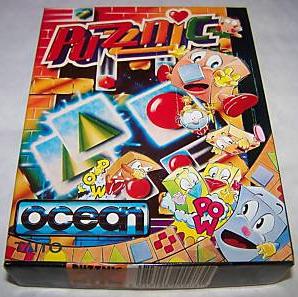
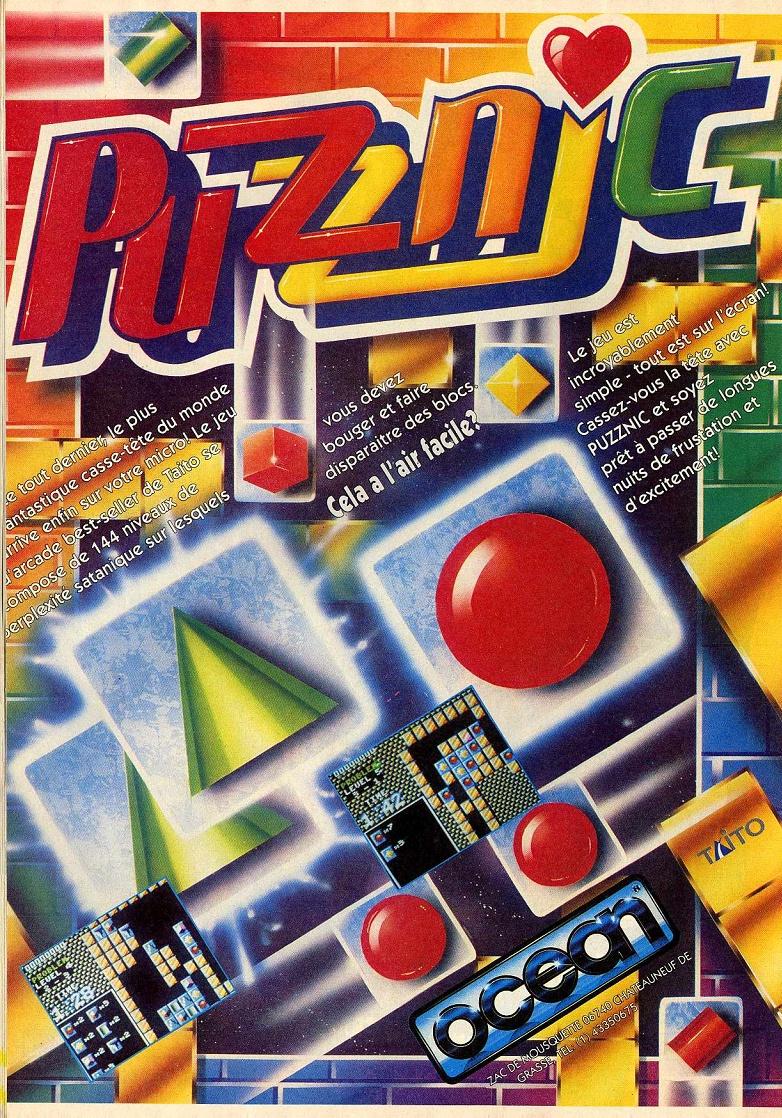
Life's a puzzle, innit? Well, it is when you're playing Puzznic. It seems that puzzle games are very much in vogue again. This summer, for example, we saw such greats as E-Motion and Pipe Mania. Games where the action concentrated on quick thinking rather than fast reflexes. It looks like we're in for a treat during the coming winter months, too. There are plenty of puzzlers on the way, the first of which is this tricky little poser from Ocean. It goes something like this. There are all these little blocks, each marked with a symbol of some kind. You can push these things around the screen. The object is to position like blocks together. When this is done they disapear. Once all have been got rid of, the level is complete, and you move on to the next one.. 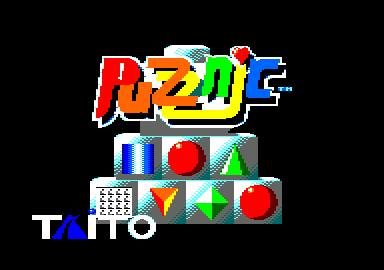
To stop things being too easy, the game has gravity. Unsupported blocks fall until they land on something solid - either another block, or a wall. Some of the screens have moving walls, too. These can be used as lifts, or as a means of transporting a block from one area of the screen to another. The blocks are moved by means of a cursor, which can be freely positioned anywhere on the playing screen. Pressing Fire selects the block, and a tap left or right shoves it across the screen. (You can't move them upwards or downwards - gravity takes care of that.) And that's all there is to it. A truly simple concept. It's when you start to play that you realise just how 'simple' can become very complicated indeed... Move the wrong block at the wrong time and you soon get yourself into trouble. It's all too easy to trap them, or end up having an odd one left over. When you finally solve a puzzle that has had you stumped for a long time, the feeling is one of elation. However, if you do get to a stage where you just can't figure out what to do, then it's not the end of the world... There are eight levels to play through. Each level conists of four puzzles, so to play a game all the way through you'd have to solve a total of 32 brain-teasers. There's far more to it than that, though. There are several 'routes'to solving the game. Level One has one set of four puzzles. Level Two has two, and so on until you reach Level Eight with eight sets of four puzzles. Those of you with lightning-fast brains (or a calculator) will have worked out that there are 144 puzzles in total, and 128 ways of getting there! The puzzles are arranged in logical order. The first ones you come across are easy enough, but they get more and more difficult as you progress. Luckily, you get three goes per game, so if (when) you make a pig's ear of the whole thing, you can learn from your mistakes and keep going without having to start all over again. 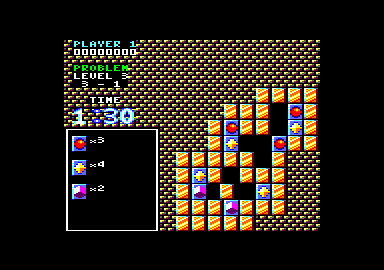 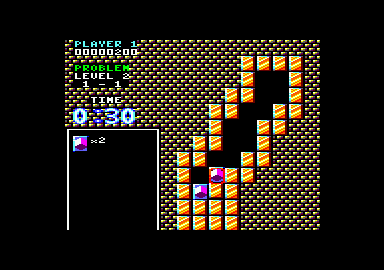
You can chose to start from any of the first three levels - that's six starting points in total. For the first few games you'll probably want to take it from the beginning so that you can get used to the idea. Once you've played a few times, though, it'd be best to take it from Level Three, so you don't have to go through the easier early stages all the time. The graphics aren't exceptional, but that's because of the style of the game rather than poor graphic design. After all, there's only so much you can do with a square block. The important thing is that the symbols are clear and can't be confused with each other. Sound, again, is very basic. A few blips and squeaks and that's it. More could have made out of this section. For instance, a frantic tune that burbles away merrily against the rapidly-decreasing time limit would have been good. Puzznic is one of those games based on a very simple idea. Appearences are (as ever) deceptive, though, and underneath it all there's oodles of mega addictive gameplay. You'll be unable to put it down until you've finished. Adam Waring, AA
|