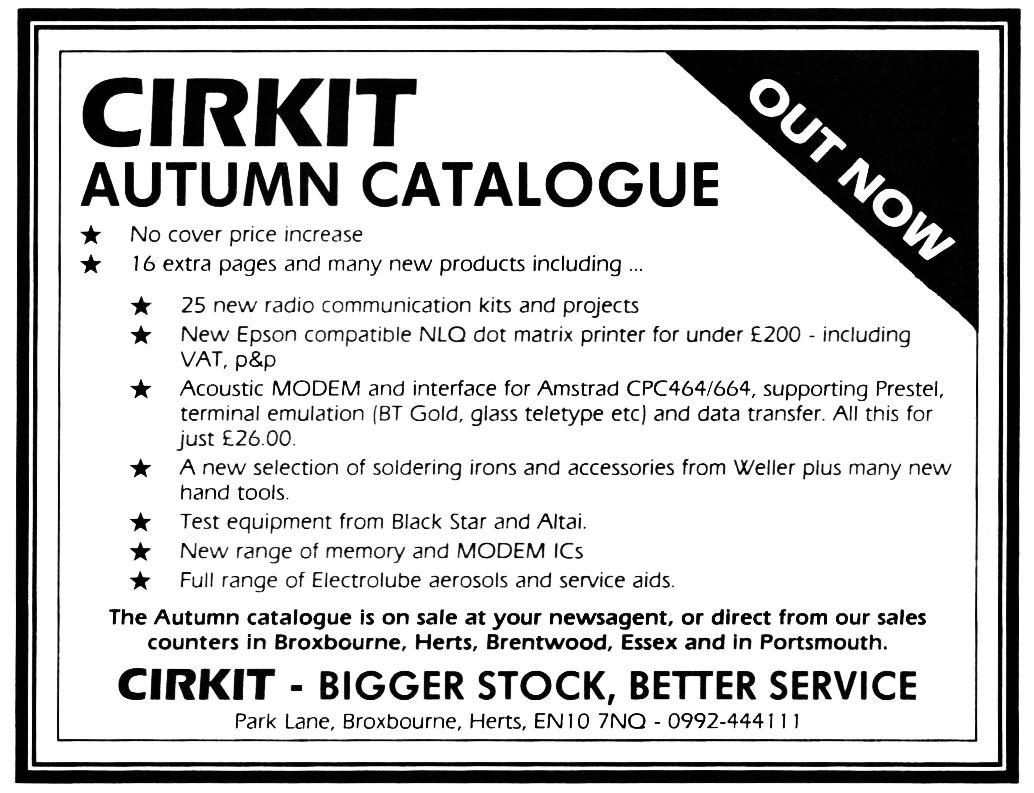
The most important thing to say about this package is that anyone with an Amstrad CPC computer should drop everything, get out their cheque books, and buy it now! It represents remarkable value for money, and whilst it may not have the sophistication of labour saving features of more expensive communicator set-ups, it provides an unparalleled opportunity for an entry into the world of Prestel, Bulletin Boards and the like. The package is a joint production from Cirkit, who produce the hardware, and Honeysoft, who have written the software. For your money you get a RS232 interface, complete with driving software, a Protek battery-driven acoustic modem (built by Cirkit) and, gratifying with such a budget purchase, some quite usable and readable documentation. The interface is not as flexible as some you can buy, it offers 75/1200, 1200/1200 and 300/300 baud rates with handshaking. The latter is surprisingly not supported by the modem supplied, but the available options are certainly sufficient to allow you to access the most popular telephone services including the new AMSNET boards for Amstrad users, and of course other modems can be fitted if the hobby really grabs you . Incidentally, the interface will not work with CP/M but the accompanying software provides you with RSX extensions to Basic which can be used in your own programs to connect with other peripherals such as printers and plotters. It uses a DIN type plug rather than a D connector.
The modem is the acoustic sort that gets both ends of the phone stuffed into it, you are probably familiar with them. It is said to be more reliable than some direct contact modems (the ones that plug into the wall telephone socket) and compatible with most standard designs of telephone, which sounds worrying for those with the standard designs of phone that will not fit. In practice you shouldn't have any problems unless you have a Mickey Mouse set or keep your phone in a tiny alcove in the hall. The accompanying software does several nice things. For a start there is no Amstrad display mode that directly corresponds to Prestel standards, 40 columns and eight colours, so you are offered the choice of operating in lowres multicolour, with the character set redesigned to produce 40 columns, or in high res four colour mode with stippling effects used to approximate to the missing colours. The last received page is held in a memory buffer so you can change modes, etc, without losing the picture. 
On loading you are given a menu choice of options, there is a Prestel mode, a terminal emulation mode compatible with Telecom Gold and the like, and a mode for sending and receiving ASCn file text or programs down the phone from one Amstrad to another. The latter has its own error detecting system.
Unless you have a specific use for a modem that exceeds these capabilities, this package is an excellent value means of testing out a new hobby and provides you with an RS232 that will work on most applications as well. Worth 30 quid of anyone's money. Tony Kendle, PopularComputingWeekly851128 |