| ★ AMSTRAD CPC ★ GAMESLIST ★ GHOST HUNTERS (c) CODEMASTERS ★ |
| MICRONEWS | Popular Computing Weekly | A100% | AMSTAR | ASM |
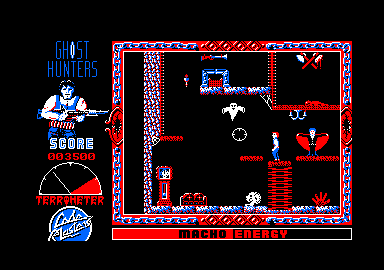
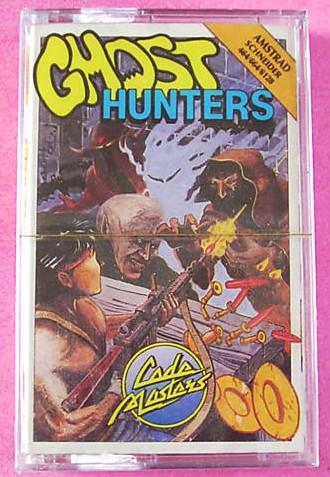
Ghost busted Codemasters has well and truly established itself as a major budget label, with a claimed 300 000 odd sales since the launch late last year. But while it does come up with some nice games, the consistency of, say Mastertronic, has yet to be achieved. A disbeliever would only have to compare a recent Spectrum release White Heat, with Ghost Hunters, here on Amstrad, as evidence. No intended disrespect to programmer Mark Baldock, but White Heat is what you might have expected from a second-rate budget label two years ago. Ghost Hunters, from the Oliver brothers, is a different matter. Here the tried and tested formula of the platforms and ladders arcade adventure has been taken and added to, creating an original and enjoyable game that, if tarted up a little in design, would have made a perfectly acceptable full price title. The scam is set in a haunted house, with you playing the part of Hunk Studbuckle, out to find his brother trapped somewhere inside. Hunk has a certain amount of life force (the Olivers call it Macho Energy!) that is diminished if ghosts, goblins or any supernatural beings appear anywhere on the screen. This happening calls for the Phantom Splatterer, a set of cross hairs controlled independently of Hunk, which you move over the display to zap evil beings. When playing single player, the sight is moved with the fire button pressed down and the stick moved in the appropriate direction -two player, one controls Hunk, the other controls the zapper. Jumpy, jumpy - zappy, zappy. All the same, it's an excellent variation on a theme. John Cook, PCW |
|  |
Page créée en 021 millisecondes et consultée 6850 fois L'Amstrad CPC est une machine 8 bits à base d'un Z80 à 4MHz. Le premier de la gamme fut le CPC 464 en 1984, équipé d'un lecteur de cassettes intégré il se plaçait en concurrent du Commodore C64 beaucoup plus compliqué à utiliser et plus cher. Ce fut un réel succès et sorti cette même années le CPC 664 équipé d'un lecteur de disquettes trois pouces intégré. Sa vie fut de courte durée puisqu'en 1985 il fut remplacé par le CPC 6128 qui était plus compact, plus soigné et surtout qui avait 128Ko de RAM au lieu de 64Ko. |