Another cheapie to help your pocket-money last. It's a simple game but a fun one. You control a “Tiegyr” surface skimmer, which you must use to blow up communication satellites. These satellites are dotted around an area called “No man's land,” represented by 3D flick-screens.
Your surface skimmer is equipped with the latest technology. You have a positronic proximity blaster - a laser gun. You also have a neutrino magnetron pulser. Movement is rotational. Each rotation amounts to a 45-degree turn left or right. You can thrust forwards or backwards. It is quite useful to be able to thrust backwards when confronted by an enemy missile zooming towards you. Every now and then, you will come across a laser gate between two toll-booths. Shooting one of these toll-booths will blow up the laser gate, allowing you to get through it. 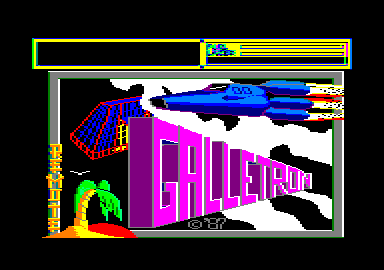 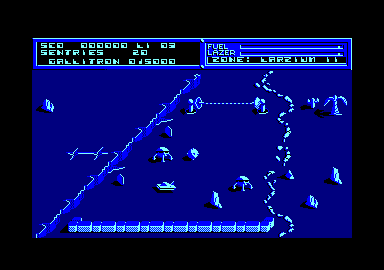 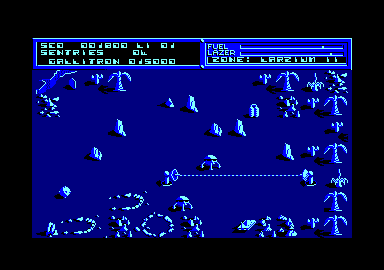
Dotted around are supplies; pick them up by passing over them. They include fuel, laser cells, extra lives and a bonus. Once you have blown up a satellite, you will be transported to the next- area. Destroying nine areas will take you to Galletron. Once here, you must destroy the central powerhouse, which is in the form of two large Teslerons and a central communications dish. If you destroy all these, you have won the war. The graphics are in a single colour, with very little detail. The scenery is drab and dull. The gameplay is good, and easy to get into, even though the control of the surface skimmer is rotational. Sound effects are almost non-existent. CB, AA The Verdict GRAPHICS 62% - Pretty and almost colourful explosions!
- Characters are small and monochromatic
SONICS 42% GRAB FACTOR 66% - Lots of objects to shoot or pick up.
- Rotational ship control.
STAYING POWER 69% - A long and arduous mission to complete.
- Three levels of play.
AA RATING 67% - Another fine game for Steve Elward's credit list.
CB, AA FIRST-DAY TARGET SCORE : 5,000 GREEN SCREEN VIEW : Dark colours - can prove awkward. | SECOND OPINION This is a simple but effective game that at the price will disappoint few people. You won *t get a mega-game but it will provide plenty of enjoyment and reasonable difficulty. I preferred Steve Elward's Back to Reality, but this isn't bad either. BW |
| 













 +
+