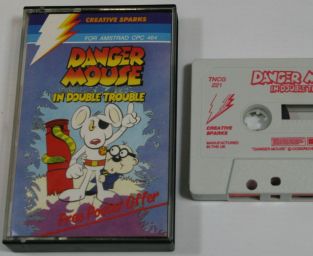
'Crikey DM, we seem to have got ourselves in a computer game now' 'Thats right Penfold, The power-mad Baron Silas Greenback and his band of international villains have been making an android of me in their jungle hideout. We've got to disable the android mouse to save the world (again)' 'Oo Eck....' Exit the dynamic duo stage left. First, our heroes must reach the jungle in DM's aero car. A various assortment of robots try to hinder this task. These robots have to be removed by selecting a picture of it on the repeller VDU display. If they match, the repellent tune is played and the robot disappears, DM is after all a hero of the young, and mindless destruction of the bad and just plain evil is just not on. Once the jungle is reached DM and Penfold must negotiate swamps by using crocodiles as stepping stones. Other perils also lurk here, monkeys, mouse eating pumas and snakes. When a puma appears DM must climb to the top of the nearest tree and do a Tarzan call to summon help. What follows next is probably the biggest cop-out in the (short) history of computer graphics, but I will spoil not the surprise by spilling the beans. With the puma out of the way our duo can continue on their way through the jungle. Finally the Baron's jungle hideout is reached. Baron Greenback controls one side of a 4 x 4 matrix and DM an adjacent side. DM must push one of the four buttons on his side of the grid when a cell which intersects on the button the baron is pressing is yellow. If he gets it right the chain of yellow light is reduced by one, otherwise one is added. When all the lights are extinguished the android mouse is disabled and the world can sleep easy in its bed. The game is fun to play, the children certainly enjoyed it. I get the distinct impression that the game was programmed by committee, the three sections are quite different in feel. In the first section the pseudo-sprites are multicolour and the game easy, whereas in section two the graphics are a lot less inspiring with single colour sprites but the game is harder to play. The programmers had sufficient sense to use palette/mode switching and other tricks of the trade so I do not think this was a lack of skill, probably an expired deadline or lack of thought. ACU #8509 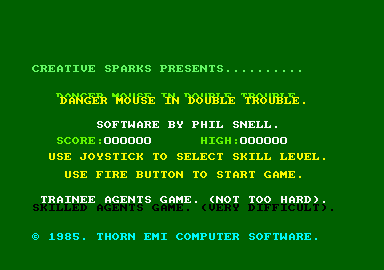 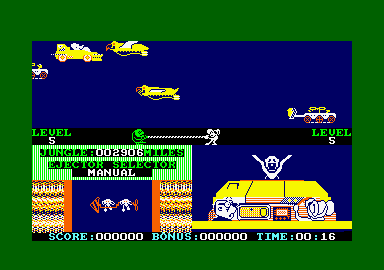 
|