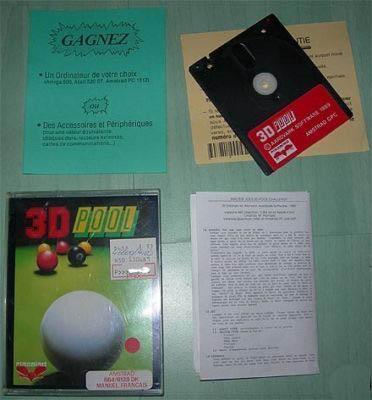
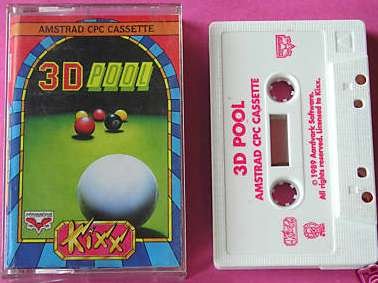
It has been observed many times that pool, snooker and billiards could be played efficiently by an idiot equipped with a book on ballistics. This can't . be quite true - as I recall, the book never helped me one single bit. Yet there's a good case for thinking that computers, with their totally logical and accurate calculating processors, could really get into pool in a big way. I cant see it myself. Can you imagine walking into a pool hall to he hustled by a plastic'n'steel Paul Newman android? Still, looking at 3D Pool you could believe that one day machines will rule the green baize. And when you consider that an android has been world snooker champ more often than anyone else... Firebird's 3D Pool - in which you compete against a variety of opponents, and finally European Pool Champion Maltese Joe himself - is just the latest in a whole series of snooker-style games that have been appearing since they become popular in the arcades around 1984. They include such classics as robotics expert Steve Davis'Snooker and CDS Pool, but they have al suffered from a shortcoming - they were all viewed from the same vantage point above the table. As the whole table had to be viewed at once, the scale of the table wasn't very big and the games become predictable. It wasn't that you could always pot the balls, but you could nearly always say that you'd miss ana by what margin. The advantage of 3D Pool is that you can walk around the table, viewing the cue ball from every angle. You can also strike at the bottom or top of the ball, in order to induce spin. That's not so new, but when you do so, the table tilts to show you the exact angle that you're aiming at. 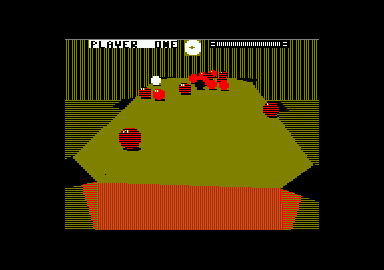 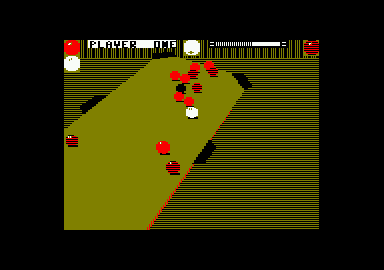 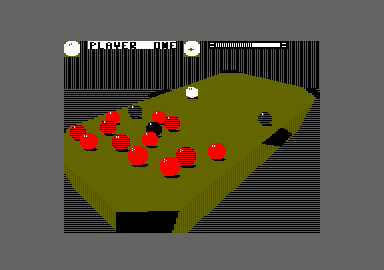
All the balls are shaded, as is the table and background. The big let down is that, although the screen is in the chunky 16 colour display mode, only 4 are actually used! Considering the way the game appears on screen (in fact it's pretty good) it could have been amazingly good. Another lost opportunity... One final point about the display: the speed at which it rotates and moves is so fast you can dip and spin enough to make you seasick. But when the computer is thinking about its shot the action is frozen. The game theory is easy enough. You have to line up the white ball to make a fair shot. The white always travels vertically up the table away from the viewpoint. This means it is easy enough to judge angles when the cue ball and object ball are close, but much trickier when they're touching or fairly distant. Progression in the game is much as by the rules. The game is based around .a tournament, with various computer controlled opponents. These range from No Hope Nik to Mighty Mike, ana they've all got their own individual styles. There are a few differences from the real game. The human always breaks in the first and last frame, with the computer taking the middle one. When a foul stroke occurs, a free ball is automatically awarded to the other player. Most disturbing of all is that there are no cushions, the balls simply bouncing back from the edge of the tabic. All of the computer opponents play extremely well. It's very disheartening to lose game after game, especially to the same player. I must have lost about fifty games to Mighty Mike alone! You soon understand though, that although the different players have different styles, the only real change between them is that if you play an easy player, the pockets are larger! You start playing, and you just can't stop. Eventually things can get serious, with a demented gamester demanding the right to play various players, and taking several hours to lose frames that should take a few minutes. My only objection to this hugely addictive game is its difficulty. It's not as devious a game as the real thing, but compared to your average shoot-em-up there is no comparison. Give me lots of 3D Pool, and I'll be happy. First day target score: win a match - any match! PbM, AA
|